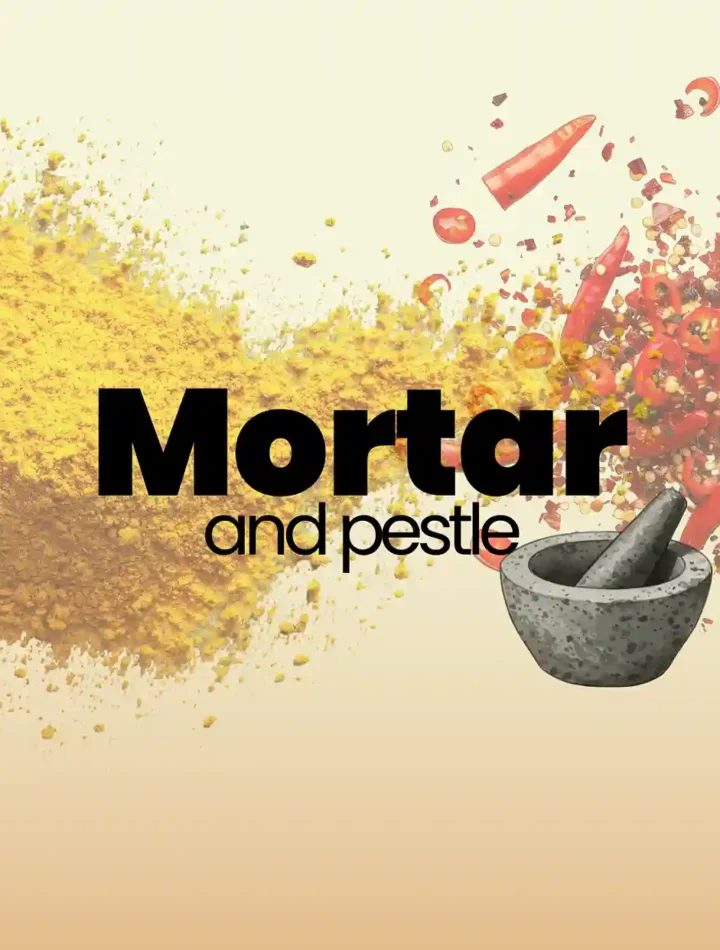
Walk into any serious Indian kitchen and you’ll probably find at least one mortar and pestle. Maybe it’s a heavy stone bowl with a blunt pestle sitting beside the gas stove. Maybe it’s a large flat grinding stone propped against the wall. Maybe it’s a small brass bowl tucked in a cabinet.
And right next to these ancient tools, you’ll probably also find a modern electric mixer or food processor.
So why do both exist in the same kitchen? If blenders and mixers are faster and easier, why hasn’t the mortar and pestle disappeared?
Because they’re not doing the same job. They look like they’re doing the same thing, grinding and crushing ingredients, but they’re actually producing different results. The mortar and pestle isn’t hanging around because of nostalgia or tradition for tradition’s sake. It’s there because for certain things, it simply works better.
The way it crushes spices releases more aroma. The way it grinds without generating heat preserves flavors. The control it gives you over texture can’t be replicated by a machine with spinning blades. And for thousands of years, Indian cooking has understood this and kept using these tools because the food tastes better.
Let’s talk about why these simple stone tools have survived into the age of electric everything, what makes them different from modern appliances, and when you should reach for the mortar instead of the mixer.
Names and Types Across India
Before we dive into how they work, let’s talk about what they’re called. Because India being India, the same tool has different names in different regions, and sometimes different forms too.
In North India, you’ll hear okhli and moosal. The okhli is a deep bowl, usually made of stone or wood, and the moosal is the heavy pestle you use to pound things in it. This is what you’d use to crush garlic, ginger, or whole spices.
Sil batta is common in North and Central India. This is different from the bowl style. The sil is a large, flat or slightly curved stone slab, and the batta is a smaller cylindrical stone you roll and press over the sil. This is used for making pastes, grinding spices, and traditionally for making things like dosa or idli batter in larger quantities.
In South India, you’ll find ammikallu in Tamil and Telugu speaking areas. This is similar to the sil batta but often bigger and heavier. The rolling stone used with it is called rubbu or rolu. South Indian kitchens traditionally used these large flat stones for everything from grinding coconut chutney to making rice flour.
The shape matters because it changes how you grind. A deep bowl mortar is great for pounding. You’re bringing the pestle down with force, which crushes whole spices or mashes garlic. A flat grinding stone is better for making pastes and working with larger quantities. You’re pressing and rolling, which creates friction and grinds things into smooth pastes.
Both styles have been used for thousands of years because they’re good at different things.
Materials Used in Indian Mortars and Pestles
Not all stone is the same. The material your mortar and pestle is made from affects how it works and what you should use it for.
Granite and Basalt
Granite and basalt are the most common materials for stone mortars in India. These are volcanic rocks that are extremely hard and have a naturally rough texture. That rough surface is actually important because it grips the spices or ingredients as you grind, preventing them from just sliding around. Granite mortars last forever. You can pound the hardest spices, grind the toughest ingredients, and it barely shows any wear. They’re heavy, which is actually good because the weight helps with grinding. You’re not fighting to keep it in place.
Marble
Marble is smoother than granite. You’ll see marble mortars more often for making wet pastes and chutneys than for grinding dry spices. The smoother surface works better with liquids and softer ingredients. It’s also slightly more porous than granite, which means it can absorb flavors and odors if not cleaned properly. Marble looks beautiful but it’s not as practical as granite for heavy-duty spice grinding.
Wood
Wood is less common for mortars in Indian cooking, but you’ll still see wooden mortars used mainly for pounding rice or grains rather than grinding spices. Wood is softer than stone, so it doesn’t work as well for hard spices like cloves or peppercorns. But for pounding rice into powder or crushing larger, softer ingredients, wood works fine and is lighter to handle.
Metal Mortars
Bronze and metal mortars exist, especially in traditional households and temples. These are usually deeper bowl shapes used for pounding rather than grinding. Metal on metal creates a different sound and feel compared to stone. But for making fine spice pastes or grinding to a smooth consistency, metal doesn’t work as well as stone. The surface is too smooth and ingredients slip around instead of getting crushed effectively.
Stone, particularly granite, remains the dominant material because it combines hardness, texture, weight, and durability in a way that nothing else quite matches. It doesn’t rust, doesn’t break easily, doesn’t absorb odors as much as wood, and that rough surface is perfect for the crushing and grinding action Indian cooking needs.
Size and Purpose
Mortars and pestles come in different sizes, and size matters because different tasks need different tools.
Small bowl mortars, maybe 3 to 4 inches across, are for daily quick jobs. You’re making ginger garlic paste for one meal. You’re crushing a teaspoon of cumin seeds for tempering. You need to pound a few green chilies with salt for a simple accompaniment. Small mortars are convenient, easy to clean, and perfect when you’re not grinding large quantities.
Medium mortars, around 6 to 8 inches, are the workhorses of most Indian kitchens. You can make enough chutney for a family meal. You can grind masala paste for a curry. You can crush enough whole spices for a biryani. They’re big enough to be useful but not so big that they’re difficult to store or too heavy to handle comfortably.
Large flat grinding stones (sil batta or ammikallu) are a different category altogether. These are for serious work. Traditionally, they were used to grind rice and lentils into batter for dosas and idlis. They’re used for making large batches of coconut chutney when you’re cooking for extended family or festivals. They’re used to grind spices in bulk. These aren’t everyday tools for most modern kitchens because they’re heavy, take up space, and the work is physically demanding. But for certain tasks, especially in South Indian cooking, nothing else gives you the same texture or consistency.
The size you need depends on what you cook and how much you cook. A small household making quick dinners can manage with small to medium mortars. A family that cooks traditional dishes regularly or makes things from scratch might want larger options.
Purpose in Indian Cooking
So what exactly are mortars and pestles best at? What should you actually use them for?
Crushing whole spices is probably the most common use. You take cumin seeds, peppercorns, cloves, cardamom, whatever spices your recipe needs, and you crush them in the mortar. This releases their essential oils immediately before you use them in cooking. The aroma is intense and fresh in a way that pre-ground spices or even electric grinding can’t quite match.
Making fresh masala pastes like ginger garlic paste, green chili paste, or more complex masalas with multiple ingredients. When you pound these in a mortar, you’re breaking down the fibers and releasing the juices, which blend together naturally. The paste has a different texture and intensity compared to machine grinding.
Bruising herbs instead of cutting or pulverizing them. Sometimes you don’t want herbs chopped fine or ground into paste. You want them bruised just enough to release flavor but still maintain some structure. Curry leaves for certain dishes, mint leaves, coriander stems. A mortar lets you control exactly how much you break down the herbs.
Controlling texture for specific dishes. Some curries need coarsely ground spices. Some chutneys should be slightly chunky, not smooth. A mortar gives you that control. You decide when to stop grinding. A machine decides for you, and usually everything ends up uniformly fine.
Dishes where manual grinding makes a real difference include traditional stone ground chutneys, certain masalas where texture matters, freshly pounded spice blends for biryanis or pulaos, and ginger garlic paste when you want it really pungent and aromatic.
History and Cultural Significance
Mortars and pestles aren’t recent inventions. They’re among the oldest cooking tools humans have ever made.
Archaeological sites in India have found stone grinding tools dating back thousands of years. Ancient Ayurvedic texts mention specific grinding techniques for preparing medicines and foods. The basic design hasn’t changed much because it works. A heavy stone, a rough surface, and manual force to crush ingredients. That’s all you need.
These tools are often passed down through generations. A grandmother’s grinding stone given to her granddaughter when she starts her own household. These aren’t just tools. They carry memories, techniques, knowledge of exactly how much pressure to apply, how long to grind for what result.
In many traditional homes, the grinding stone is treated with respect. It’s cleaned carefully, sometimes even given a ritual washing. Not because of superstition but because it’s valuable. Both practically and sentimentally.
The fact that the design has barely changed over thousands of years tells you something important. When something works perfectly for its purpose, there’s no reason to change it. Modern materials might be added (stainless steel pestles, machine-polished granite), but the fundamental principle remains the same because the fundamental purpose remains the same.
The Science Behind Manual Grinding
Let’s talk about what actually happens when you grind spices or make paste in a mortar versus a blender. Because the difference isn’t just romantic tradition. There’s actual science here.
Flavor release through crushing. When you pound spices in a mortar, you’re crushing them. That crushing action breaks the cell walls of the spice and releases the essential oils trapped inside. These oils contain the aroma and flavor compounds. The rough surface of the stone helps tear apart the cell structure more effectively than smooth blades cutting through.
Heat control. Blender blades spin at extremely high speeds. That creates friction, and friction creates heat. Even if you only blend for a few seconds, there’s some heat generation. For spices, heat can cause volatile aroma compounds to evaporate or change. When you manually grind in a mortar, there’s no motor heat, no friction heat beyond what your hand generates (which is minimal). The spices stay cool, and those delicate aromatics stay intact.
Texture control. This is huge. A blender or mixer gives you one kind of texture, a uniform grind. Everything becomes the same consistency. With a mortar, you control exactly how fine or coarse you grind. You can have some larger pieces, some finer powder, some in between. For certain dishes, that varied texture is exactly what you want. It creates layers of flavor as you eat, some bites stronger, some milder.
Oxidation. Blenders incorporate air as they spin, which means your ground spices or pastes are exposed to oxygen. Oxygen causes oxidation, which can dull colors and fade flavors. Grinding manually incorporates much less air. Your spice powder stays brighter in color and fresher in taste. If you’ve ever noticed that freshly ground black pepper from a mortar smells more intense than what comes out of an electric grinder, this is partly why.
None of this means blenders are bad. They’re excellent for what they do. But they do different things at a molecular level, and those differences affect flavor, aroma, and texture in ways you can taste.
Mortar and Pestle Versus Mixie, Blender, and Food Processor
Let’s be clear about what we’re comparing here. These aren’t the same tools in different forms. They work differently and produce different results.
Mortar and pestle uses a crushing and grinding action. You’re applying force downward or in a rolling motion. This breaks ingredients by compression and friction against the rough stone surface. The action is slow and manual, which means you have complete control. You’re working with small batches, usually just what you need for one meal. The texture can be varied, anything from coarsely crushed to fine paste, depending on how long you grind. And the aroma that’s released is immediate and intense because you’re crushing everything fresh right before use.
Electric gadgets like mixies, blenders, and food processors use a cutting action. Sharp blades spin at high speed, cutting through ingredients. This is fast and efficient. You can grind large quantities in seconds. But the blade action is different from crushing. It cuts rather than tears apart cell walls. The high speed generates some heat. And because everything gets cut uniformly, you get one consistent texture rather than varied grinding.
Both have their place. The question isn’t which is better in absolute terms. The question is which is better for what you’re trying to do.
A mortar and pestle gives you maximum aroma, better control over texture, no heat generation, and preserves volatile flavors. But it’s slower, requires physical effort, and only works for small batches.
Electric grinders are faster, handle large volumes easily, require no physical effort, and give you uniform results. But they generate some heat, incorporate air, give less control over texture, and the flavor is subtly different.
They’re not replacements for each other. They’re different tools for different jobs.
When to Use Traditional Tools Versus Modern Appliances
So when should you actually pull out the mortar and pestle instead of just hitting the button on your mixer?
Use the mortar when flavor matters most. You’re making a special meal, you want maximum aroma from your spices, you’re making a dish where the freshly ground spice flavor is central to the result. Biryani masala, for example, tastes noticeably better when spices are freshly crushed in a mortar right before cooking compared to using pre-ground or even electrically ground spices.
Use the mortar for small quantities. If you just need a tablespoon of crushed coriander seeds or a small amount of ginger garlic paste, pulling out the mixer jar, grinding, and then cleaning it is more work than just using a mortar. The mortar is actually faster and more convenient for small amounts.
Use the mortar when texture control matters. Some chutneys should be chunky. Some masalas need varied grinding. The mortar lets you stop exactly when you want that texture. A mixer makes everything uniform.
Use electric grinders when you need speed and quantity. You’re making a large batch of something. You’re grinding rice and dal for dosa batter. You’re making masala powder in bulk to store. You’re in a hurry and need something done fast. This is when modern appliances make sense. They’re efficient and practical.
Use electric grinders for things that don’t depend on aromatic intensity. If you’re just making a smoothie or blending vegetables for soup, the difference between crushing and cutting doesn’t matter as much. Use what’s convenient.
The hybrid approach makes the most sense for most modern kitchens. Keep both. Use the mortar for small batches of spices, for special dishes where flavor matters, for things like ginger garlic paste or green chili crushing. Use the mixer for batter, for large quantities, for everyday convenience when you’re pressed for time.
You don’t have to choose between tradition and convenience. You choose the right tool for what you’re cooking.
Why These Ancient Tools Still Matter
Here’s what it comes down to. Mortars and pestles have survived thousands of years and continue to exist in modern kitchens because they produce results that machines cannot perfectly replicate.
That intense aroma when you pound cumin seeds fresh in a stone mortar, that perfect texture of a traditional coconut chutney ground on a stone, that pungent ginger garlic paste that seems more flavorful than the mixer version. These aren’t imaginary differences. They’re real, and people who cook regularly can taste them.
The mortar and pestle isn’t about rejecting modern convenience. Most people who use mortars also own mixers and use both. It’s about understanding that different techniques produce different results and choosing appropriately.
It’s about control. Manual grinding gives you complete control over texture, timing, and the final result in ways that pressing a button doesn’t.
It’s about preserving flavor. The lack of heat generation, the crushing action that releases essential oils, the minimal oxidation, all of these preserve the volatile compounds that make spices and aromatics taste and smell the way they should.
And yes, it’s also about cultural continuity. Using the same tools your grandmother used, grinding spices the same way generations before you did, maintaining techniques that have been tested over centuries. That matters too. Not as nostalgia but as preserved knowledge. These techniques survived because they work.
Modern appliances are wonderful. They save time and effort. They make cooking more accessible to people who might not have the strength or time for manual grinding. They’ve earned their place in kitchens.
But so have mortars and pestles. They’ve earned their place by consistently producing flavor, texture, and aroma that people want and that machines struggle to match.
That’s why they’re still here. That’s why serious cooks still reach for them. That’s why they’ll probably be around for another few thousand years.
Not because of tradition. Because they work. And in cooking, working matters more than anything else.
FAQ
What is a mortar and pestle used for in Indian cooking
A mortar and pestle is used to crush and grind spices, herbs, and fresh ingredients like ginger, garlic, and chilies. The manual crushing action releases natural oils and aromas that are difficult to achieve with electric appliances.
What are Indian mortars and pestles made from
Most traditional Indian mortars and pestles are made from heavy natural stone such as granite, basalt, or marble. These materials provide the rough surface and weight needed for efficient grinding and long-term durability.
Why does food taste better when ground using a mortar and pestle
Manual grinding breaks ingredient cell walls without generating excess heat. This preserves volatile aromatic compounds and essential oils, resulting in deeper flavor and fresher aroma.
Is a mortar and pestle better than a mixer or blender
A mortar and pestle is better for small quantities and flavor-intensive preparations. Mixers and blenders are better for speed, large batches, and liquid-heavy tasks. Each tool serves a different purpose.
Which size mortar and pestle should I choose for home cooking
Small bowl-shaped mortars are ideal for daily spice grinding and pastes. Larger flat stones are better for chutneys, masalas, and batter preparation for families.
Can a stone mortar and pestle damage modern countertops
Yes, due to their weight and hardness. It is best to place them on a folded cloth or rubber mat while using them to protect countertops.
Are wooden or metal mortars used in Indian kitchens
Wooden and metal mortars exist but are less common for spice grinding. Stone is preferred because it provides better friction, does not react with food, and lasts for generations.
Is using a mortar and pestle more healthy
Yes, it can be. Manual grinding reduces oxidation and preserves nutrients and natural oils in spices and herbs. It also avoids microplastic exposure associated with some electric appliance parts.
Can beginners use a mortar and pestle easily
Yes, it is beginner-friendly. With a little practice, anyone can learn to control texture and pressure. Many traditional recipes rely on simple crushing rather than fine grinding.
What is the difference between ammi and ural
Ammi is a flat grinding stone used to grind ingredients into smooth or semi coarse pastes. Ural is a deep stone mortar used to pound and break grains, lentils, and spices into coarse textures.
Can a mixer grinder replace ammi and ural
A mixer grinder can replace them for convenience but not for texture and flavor. Mixers overheat ingredients and create uniform pastes, while ammi and ural allow control and preserve aroma.